
 Elliot
 By Elliot Marsh, travel journalist who has spent 8 years reporting on how airlines set fares

Last summer, US senators warned that Delta’s AI pricing could push fares “up to each consumer’s personal pain point.”
That phrase made headlines. It shouldn’t have surprised anyone who follows airline pricing.
I’ve spent 8 years writing about how fares are set, and the direction has been clear for a while: the guessing used to be done by people, and more of it is now done by software.
Its job is the same – estimate what you’ll tolerate – only it does it faster, and all day long.
I’m going to explain how it thinks, as far as the airlines have said publicly. And the one thing it can’t do.
What “pain point pricing” actually means
Every route carries a willingness-to-pay estimate – a running guess at the most a given type of traveler will swallow before walking away.
Business route on a Monday morning? High estimate.
Leisure route in shoulder season? Lower.
Demand triggers move it in real time: searches spiking, a rival’s flight filling, fuel ticking up. “When I did this by hand, I updated numbers a few times a day,” one former pricing manager told me. “The AI does it continuously.”
The senators’ letter said out loud what the industry built quietly – what Delta described is where the whole industry is heading, not one company’s invention.
Your tricks stopped working years ago
You’ve seen the backlash in every travel forum: incognito mode, clearing cookies, booking Tuesdays, VPNs.
Here’s the uncomfortable truth from the people who ran those systems. Those hacks were never really the lever – airlines aren’t watching your browser, and repricing happens on their side, for everyone.
The folk wisdom got one thing right, though: timing is everything. Just not the way you think.
Across 300 discounted fares the app I’ll get to flagged this summer, the typical one sat about $360 below the route’s usual price – and if you fly for work, multiply that by every trip on your calendar this year.
That’s the vacation you didn’t take, funded by the fares you didn’t question.
The frequent flyer who knew every trick
Neil Garvey is 52, a sales director out of Houston, 30 flights a year. Incognito windows. Tuesday bookings. Points math at a level that scares his accountant.
Then came the trip that broke his faith. He and a junior colleague booked the identical route, same dates, hours apart. The colleague’s screen showed it for hundreds less.
Neil ran every trick he had, twice. The price didn’t blink.
“I thought I was gaming the system,” he told me. “The system was gaming me.”
The one thing their AI can’t do
That’s when Neil saw the real problem: he’d been bringing human tricks to an algorithm fight.
Here’s the weakness I promised you. To sell a seat, the machine has to show its price.
Every time it opens a cheap fare – to fill a soft flight, to answer a rival – that fare is public for the minutes or hours it lives.
The AI can price you. It cannot hide the openings from something watching all day.
That something exists. RatePunk is a flight deal app whose algorithm scans 150M fares a day and monitors your home airport 24/7, across airlines and booking sites.
Their AI works out the most you’ll tolerate. This one works out the least you could pay – and tells you when it appears.
Every fare gets an AI Deal Score from 0 to 100. Only fares that clear an 80+ Deal Score reach you, with route, dates, price and a direct booking link.
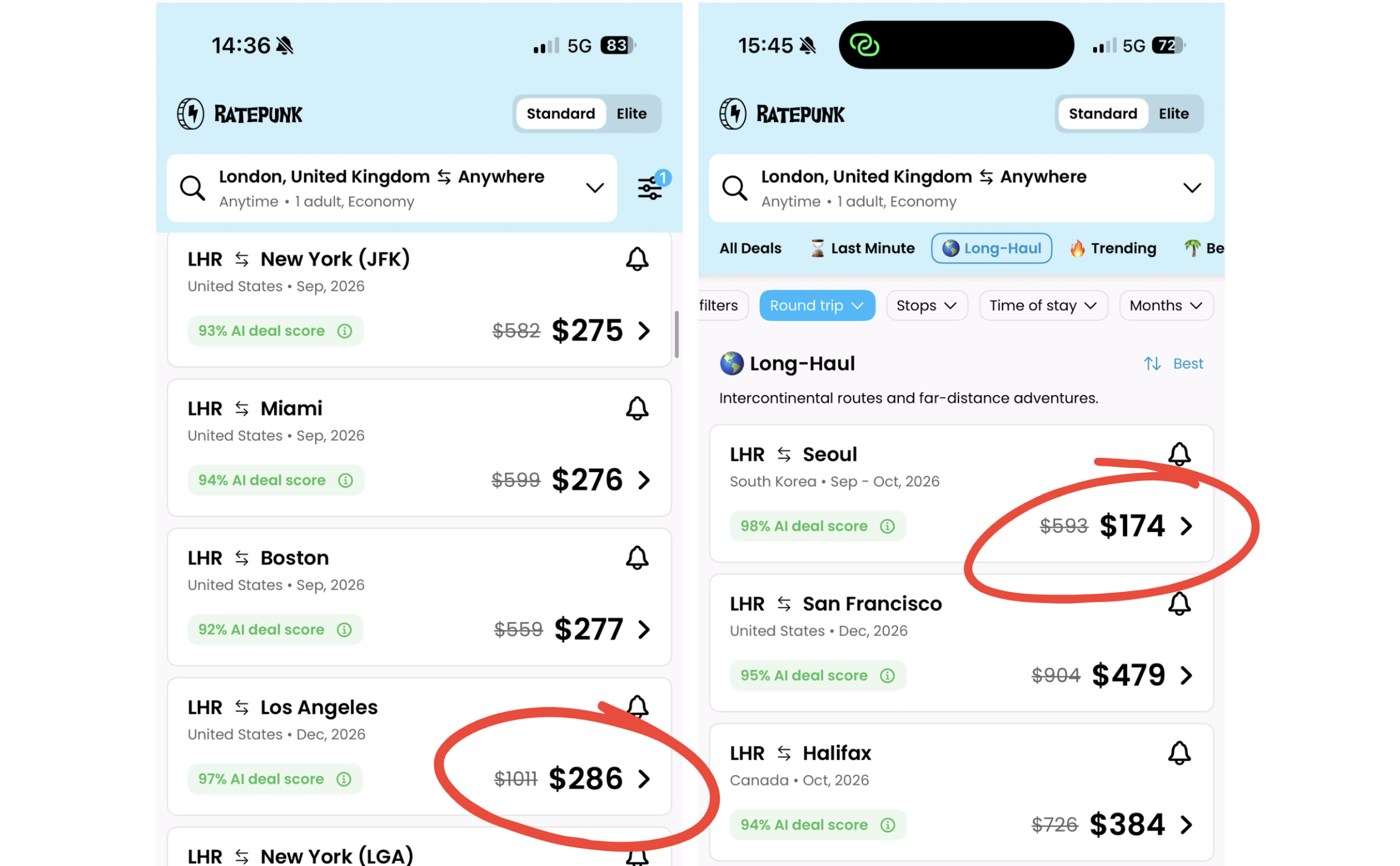
The numbers, all checkable: 300,000+ members. 4.7 stars on the iOS App Store, 4.6 on Google Play. A filter that throws away every fare scoring below 80 (out of 100).
“RatePunk is easy to use and gives the peace of mind that I get the best prices when shopping for flights.”
– Laurent H., US
What the counter-algorithm has caught:
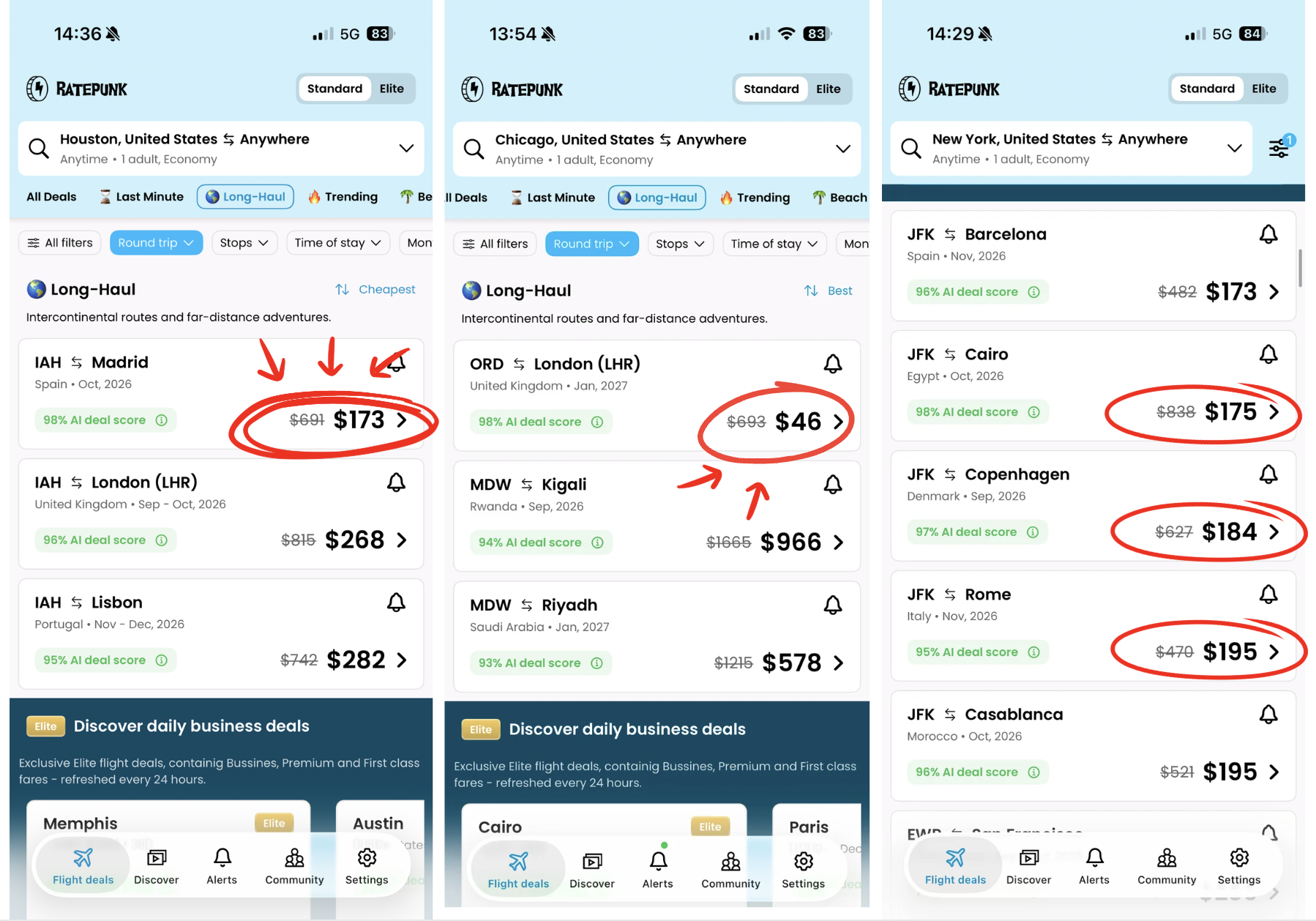
→ Chicago to London: $50 round trip, usually $693 (rated 96/100)
→ Houston to Madrid: $173 round trip, usually $691 (rated 98/100)
→ Houston to London: $268 round trip, usually $815 (rated 96/100)
→ London to Los Angeles: $286 round trip, usually $1,011 (rated 97/100)
The first one is a 93% drop – that is where “up to 90%” comes from, not from a promise.
How it works
1. Airport. Pick your home airport – or search city-to-city, or fully flexible (“Anywhere, Anytime”).
2. Algorithm. It scans fare data 24/7 and scores every fare from 0 to 100.
3. Alert. When something clears 80+, it lands by email or push. RatePunk isn’t a booking site – you book through the link yourself.
The questions a skeptic should ask
Is it legitimate? The 300,000+ members and app-store ratings are checkable, and you book directly with the airline or booking site yourself.
Will it cover my city? You set your own home airport, and the flexible modes reach beyond it.
Too good to be true? I’ve spent 8 years asking that question of airlines, so I’ll answer as the skeptic I am: it’s selectivity.
Most fares never clear an 80+ Deal Score – what reaches you is the exception, not the norm.
The promise is savings of up to 90% on flights – Chicago to London at $50 was one – only when the data says so.
Setup takes about a minute. If nothing clears 80 for your airport, a minute is all you’ve spent.
Stop being the pain point
Neil still flies 30 times a year. Their AI still prices him – it just doesn’t get the last word anymore. Alerts like that $268 Houston–London fare above reach him first.
• Set your home airport once
• The algorithm watches fares 24/7, like theirs does
• Only 80+ Deal Score fares reach you, with a direct booking link
Fares like these stay open for minutes to hours before the machine reprices. That’s not a deadline. It’s just how their side works.
| IMPORTANT NOTE: Since this article was published, RatePunk has seen a surge of sign-ups. As a courtesy, readers here can still join with 77% off. |
Sources: ABC News • AltexSoft • OAG • Thrifty Traveler • Going • Deal figures: RatePunk app screenshots, 30 July and 2 September 2026; savings gap from 300 economy fares rated 80+, 30 July-7 September 2026.


