
 Victoria
 You’ve been saving in a currency the airline can devalue overnight, and it is entirely legal. Here’s the fine print, the three questions I put to every program, and what actually books the seat: a $932 business class fare to Rome on a route where that cabin usually runs $5,161.
By Helen Carrigan, consumer travel writer covering airline loyalty programs, 12 years on the beat

Craig Ellison saved for nine years toward two business class seats to Rome. When he finally went to book, the same award cost nearly double the miles. Nothing in his account had changed, except what it was worth.
Published valuations put a Delta mile at a little over a cent and a United mile at a little under one and a half, and under dynamic pricing an international business class award often works out below a cent a mile.
Here’s the way I’ve come to think about it. You’ve been making an interest-free loan to an airline, and the airline sets the exchange rate.
The fine print nobody reads
Most of the big US programs dropped their published award charts, so the miles cost of a seat now floats, set by software and adjusted continuously.
The programs that still publish a chart just raise it. Your balance sits flat while the price of what you’re saving for drifts up.
If a bank did this to a savings account there would be hearings.
As it is, the US Department of Transportation opened an inquiry into the four largest airline loyalty programs over exactly this: devaluation, dynamic award pricing and the fees attached.
And notice who profits twice. Miles get sold to credit-card partners at one value, then what they buy gets decided later.
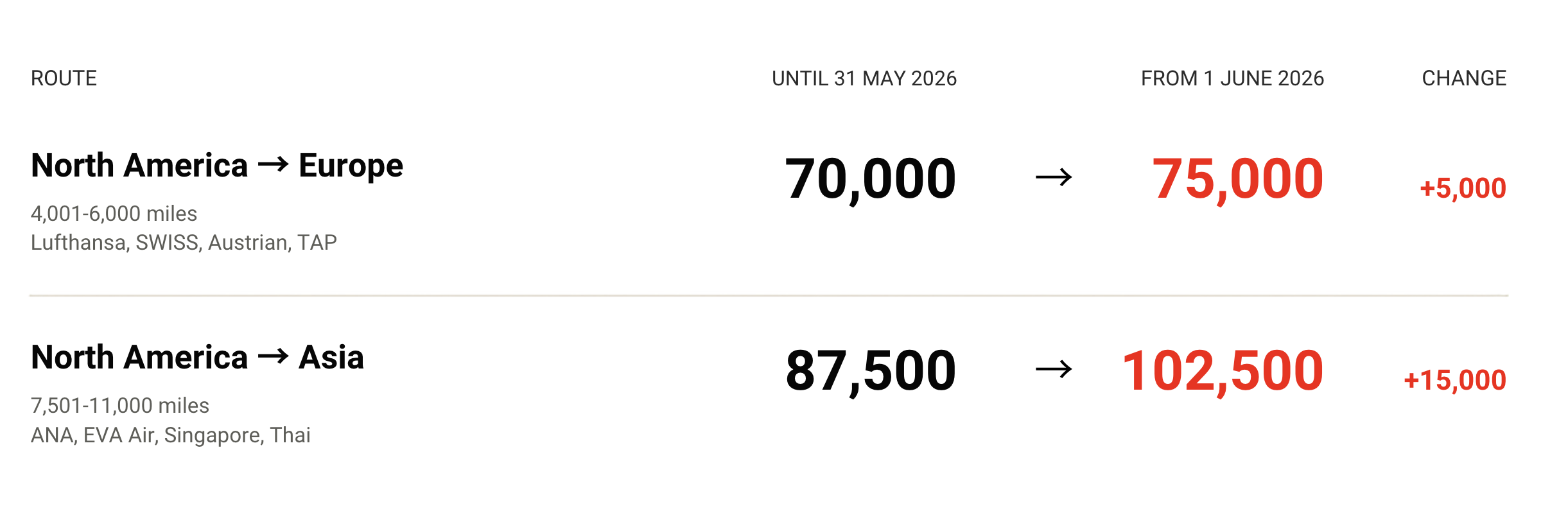
Air Canada Aeroplan’s partner award rates, before and after the change that took effect 1 June 2026. Aeroplan raised partner rates on dozens of routes in the same update.
The argument you’ve seen in every travel forum
“Are miles even worth earning anymore?” Wrong question.
Miles aren’t worthless. They’re unstable.
Those are different problems, and the difference is this: hoarding for a someday-seat stopped working, because the price of someday is no longer fixed.
The three questions I put to every program
1. Price the seat both ways. Divide the cash fare by the miles price. Below about a cent a mile, you’re trading down.
2. Check whether the program still publishes an award chart. If the price floats, your seat can reprice overnight.
3. Ask who controls the price of what you’re saving for. If it’s the seller, stop saving and start spending.
Craig’s Rome seats
Craig is 55, a project consultant based outside New York who flies constantly for client work, the kind of flyer who thinks he’s seen every trick.
For nine years every mile had a purpose: two business class seats to Rome for his 30th anniversary. Then he opened the booking page.
The number he’d been saving toward had nearly doubled. No announcement, no notice. A price set in a currency only one side can print.
“I did everything right,” he told me. He did. The rules changed underneath him.
Price the seat in a currency they can’t touch
What I told Craig: stop measuring the seat in their currency. Measure it in cash. A price that moves, yes, but one that can move your way.
Airlines fill empty premium seats by dropping the fare, for minutes to hours, then it’s gone.
The big search sites serve averaged, out-of-date results, so by the time you look it’s usually closed.
That’s the homework RatePunk does: a flight deal app that watches fares from your home airport around the clock, scanning 150 million fares a day across airlines and booking sites.
Every fare gets an AI Deal Score from 0 to 100, and only fares clearing 80 reach you, with the route, the dates, the price and a link to the booking page.
One thing to know up front, because every fare in this article is one: membership covers economy. Business, first and premium economy finds live on a separate Elite plan, which you switch on inside the app once you’re in.
The numbers: over 300,000 members, 4.7 stars on the App Store, 4.6 on Google Play.
“RatePunk has given me an option for when I want to visit my sons. I am no longer trapped into paying full price.”
– Betsy Ayres, US
When readers ask what cash actually buys in a premium cabin now, I send them recent alerts instead of arguing.
These are all Elite finds, caught this summer:
→ New York to Rome, Business Class on Norse Atlantic: $932 round trip, usually $5,161 (rated 97/100)
→ Las Vegas to Aruba, First Class on American: $1,613 round trip, usually $10,717 (rated 93/100)
→ Seattle to Bogotá, Business Class on United: $942 round trip, usually $4,262 (rated 92/100)
→ Los Angeles to Liberia, Costa Rica, First Class on Alaska: $1,499 round trip, usually $7,215 (rated 98/100)
→ Miami to Munich, Business Class on Icelandair: $2,072 round trip, usually $4,092 (rated 95/100)
→ Houston to Memphis, First Class on United: $337 round trip, usually $727 (rated 95/100)
The biggest drop above is 85%.
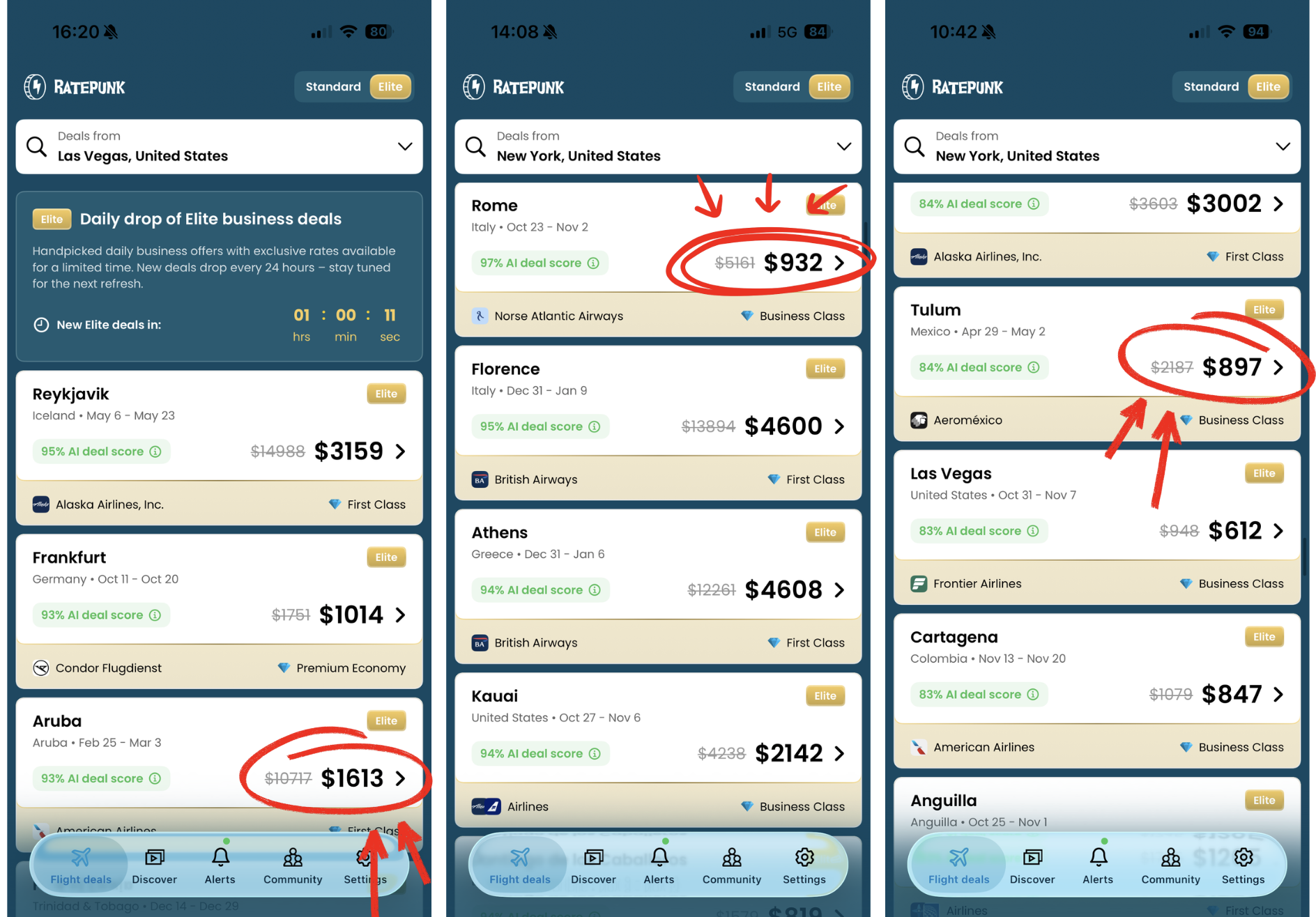
Craig’s setup took a minute.
He set New York as his home airport, switched on Elite because economy was never what he was after, and let it run. You can also search city-to-city, or go fully flexible with “Anywhere, Anytime”.
When something clears 80, a notification lands on your phone.
One clarification worth making: RatePunk isn’t a booking site. The alert takes you to the fare and you book it yourself, with the airline or the booking site.
Where I’d push back on my own article
I’ve spent twelve years checking claims that sound like this one, so here’s the part worth pressing.
This only works if the filter stays strict, and strict means most days bring you nothing.
That’s the actual trade. You’re not getting a stream of deals, you’re getting the occasional one worth acting on, and you have to be willing to sit through the quiet in between.
It also asks you to travel on the fare’s timing instead of your own, which is the one thing the miles never demanded.
The difference is that the price is fixed the second you book it. Nobody can reprice what you already own.
Where that leaves your balance
If you take one thing from this article, take this: your miles are a currency someone else controls, and the seat you want is for sale every day in a currency they can’t touch.
Value your balance with the three questions above, and spend it sooner than feels comfortable.
Then let software watch the cash fares, which is how the $932 Rome seat above got caught. Fares like these stay bookable for minutes to hours before they reprice.
That’s not a sales deadline. It’s just dynamic pricing, working for once in your favor.
Craig is going to Rome. Not with the miles.
| IMPORTANT NOTE: Since this article was published, RatePunk has seen a surge of sign-ups. As a courtesy, readers here can still join with 77% off. |
Sources: NerdWallet (DOT inquiry) • One Mile at a Time • Upgraded Points • 10xTravel • Going • Mighty Travels • Deal figures: RatePunk app screenshots, 4 and 7 September 2026.


