
 Elliot
 The surge is real – measured, reported, printed on your last booking confirmation. What nobody tells you: a small group of travelers isn’t paying it. Dana paid $732 for Dublin this spring. Her coworker – same airport, same month – paid $352. Here’s how the system I’ve spent 8 years reporting on makes that possible.
By Elliot Marsh, travel journalist who has spent 8 years reporting on how airlines set fares

According to industry reporting this spring, US airfares are up 20.7% year over year – and 21.6% in just four months, after fuel costs jumped.
I’ve spent over 8 years reporting on how those prices get set, and interviewing the people who set them.
Let me say the part that’s been sitting badly with me: the surge isn’t hitting everyone.
A small group of travelers is still flying at last year’s prices.
How a surge actually happens behind the fare
Every flight is sold out of fare buckets – the same seat at a dozen different prices.
Software opens and closes them all day on demand triggers: searches spiking, a competitor filling up, fuel moving.
On top sits a willingness-to-pay estimate for every route and season.
When fuel spiked this year, those estimates moved up – and the cheap buckets started closing faster.
A pricing manager I interviewed put it plainly: “I’ve watched a half-empty Tuesday flight hold a four-figure fare all afternoon because the model said someone would pay it.
Someone did.
I’m not proud of how well it works.”
The mistake almost everyone is making right now
The argument is in every travel forum this year: fares are insane, book months ahead, clear your cookies, wait it out.
The complaints are half-right. Fares really are up, and timing really matters.
But it’s not your cookies – airlines aren’t watching your browser. Repricing happens on their side, for everyone. What the forums miss: a surge raises the average. It doesn’t delete the exceptions.
Cheap buckets still open in 2026 – to fill a soft flight, to answer a competitor. They close in minutes to hours. The big search sites, serving averaged and cached results, mostly never show them.
That’s the exempt group’s whole secret: they’re there in the minutes the bucket is open.
What absorbing the surge costs you
Across 300 discounted fares the app I’ll get to flagged this summer, the typical one sat about $360 below the route’s usual price.
That is the gap between searching and being told – before any of this.
Stack 21% on top and the trips you took for granted – the family visits, the one real vacation – quietly become the thing you do less.
Dana paid it twice
Dana Holloway is 46, a hospital scheduling coordinator from Chicago. She books the same two family trips every year. This spring both fares came back about 50% higher – her routes running hotter than the average. She winced and paid. Twice.
Then a coworker leaned over with a phone. An alert for the exact Dublin trip Dana had priced the week before: $352 round trip, against the $732 she’d been staring at.

Dana had paid the surge like a tax. Her coworker – same airport, same month – hadn’t.
“What am I doing wrong?” she asked. Wrong question. She wasn’t doing anything wrong.
The exempt group, explained
Here’s the conclusion I couldn’t avoid: in a market that reprices all day, whoever searches pays the average – the exempt group is whoever’s watching when the bucket opens.
That’s what the coworker’s phone was.
RatePunk is a flight deal app that scans 150M fares a day and watches your home airport 24/7, across airlines and booking sites – the consumer version of the software the airlines run against you.
Every fare gets an AI Deal Score from 0 to 100.
Only fares that clear an 80+ Deal Score reach you – with route, dates, price and a direct booking link.
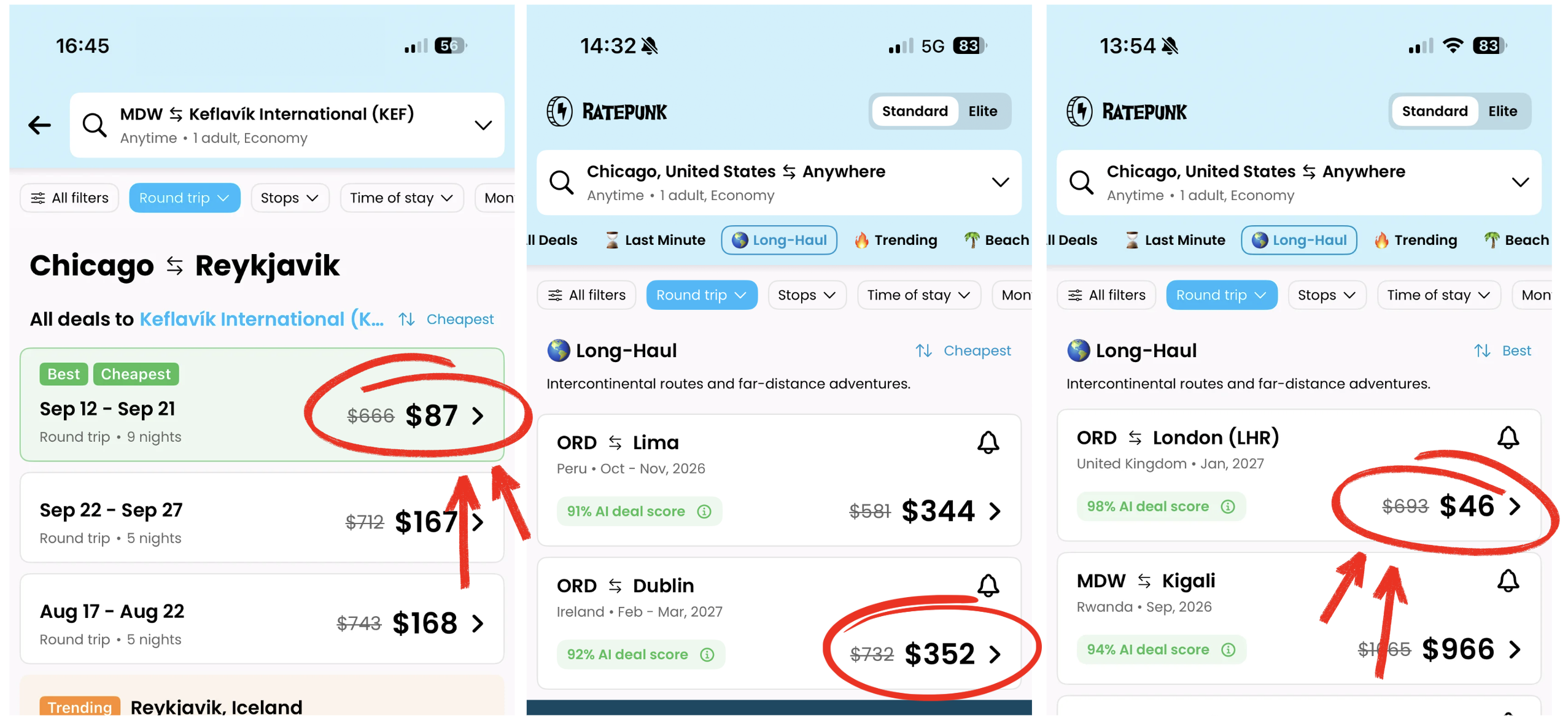
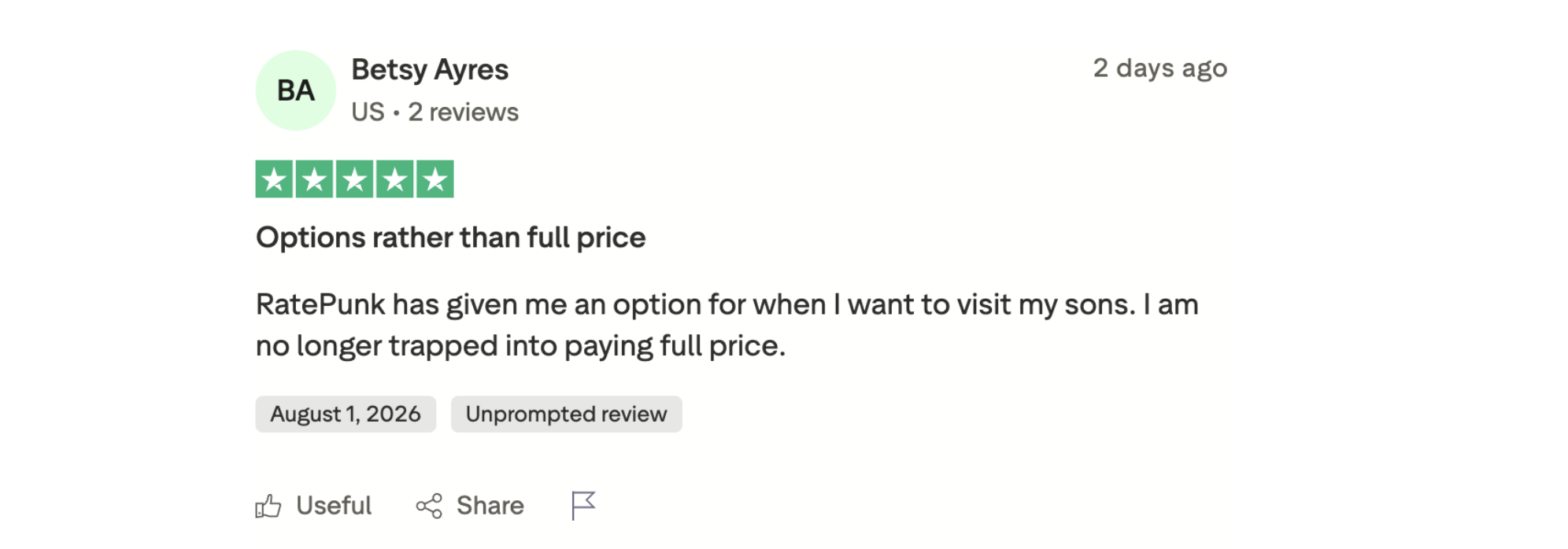
The numbers, all checkable: 300,000+ members. 4.7 stars on the iOS App Store, 4.6 on Google Play. And a filter that discards every fare scoring below 80 (out of 100).
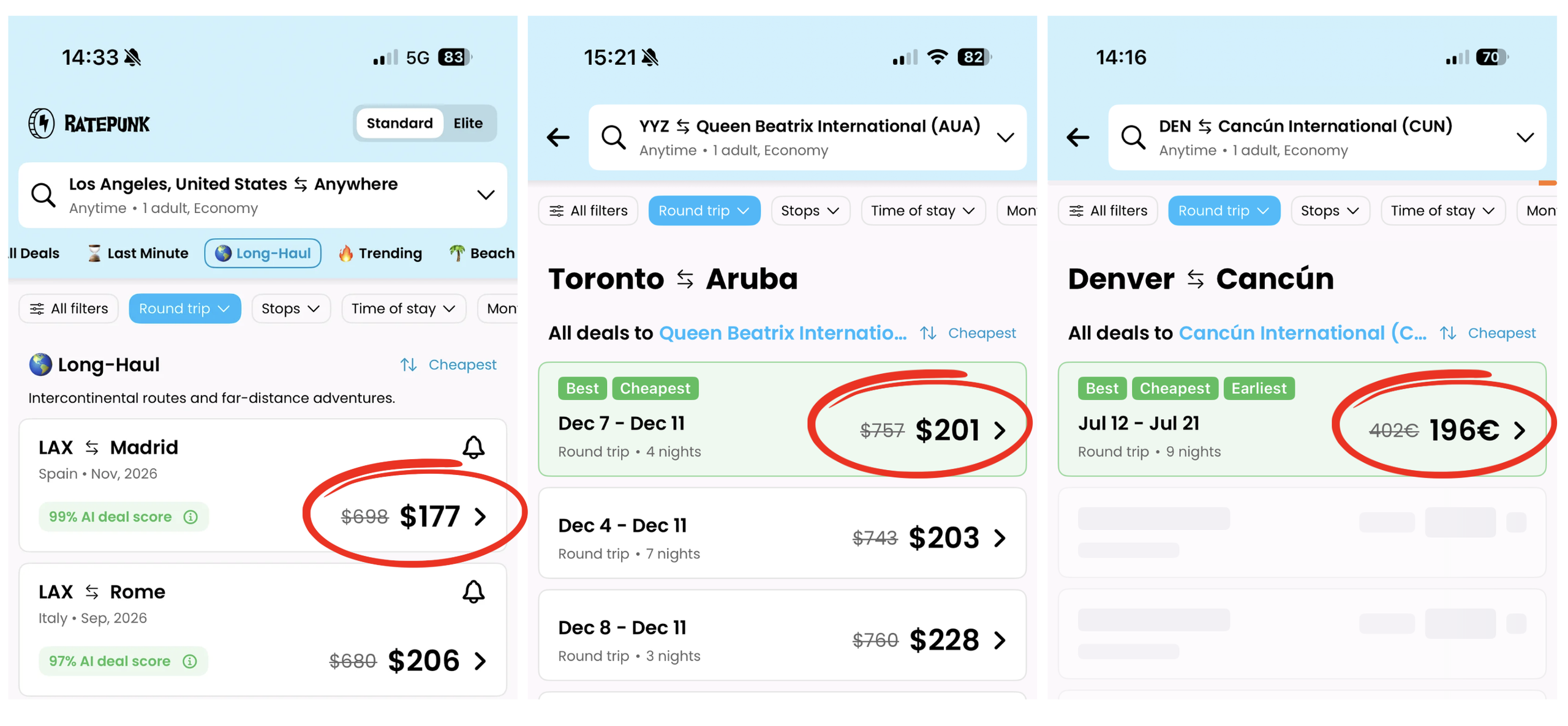
Fares members caught during the surge:
→ Chicago to London: $50 round trip, usually $693 (rated 96/100, caught 2 September 2026)
→ Houston to Madrid: $173 round trip, usually $691 (rated 98/100, caught 30 July 2026)
→ Dallas to Dublin: $351 round trip, usually $924 (rated 94/100, caught 30 July 2026)
→ Chicago to Lima: $344 round trip, usually $581 (rated 91/100, caught 30 July 2026)
The first one is a 93% drop – that is where “up to 90%” comes from, not from a promise.
How it works
1. Airport. Pick your home airport – or search city-to-city, or fully flexible (“Anywhere, Anytime”).
2. Algorithm. It scans fare data around the clock and scores every fare from 0 to 100.
3. Alert. When something clears 80+, it arrives by email or push. RatePunk isn’t a booking site – you book through the link yourself.
The questions I’d ask
Is it legitimate? The 300,000+ members and the app-store ratings are checkable, and you book through the airline or booking site yourself.
Will it work from my city? You pick your own home airport, and the flexible modes cover routes beyond it.
Too good to be true in this market? Right instinct – I’ve spent 8 years asking that question for a living. The answer is selectivity: most fares never clear an 80+ Deal Score, so what reaches you is the exception, not the norm. The promise is savings of up to 90% on flights – Chicago to London at $50 was one – not every day, just when the data says so.
Setup takes about a minute. If nothing clears 80 for your airport, you’ve spent a minute.
Stop absorbing the surge
Dana set up her alerts the same afternoon – alerts like that $352 Dublin one above. The surge didn’t end. Her part in it did.
• Set your home airport once
• The algorithm watches fares 24/7
• Only 80+ Deal Score fares reach you, with a direct booking link
Fares like these stay bookable for minutes to hours. That’s not a deadline. It’s just how the buckets work.
| IMPORTANT NOTE: Since this article was published, RatePunk has seen a surge of sign-ups. As a courtesy, readers here can still join with 77% off. |
Sources: Simple Flying • AltexSoft • KPMG • AltexSoft (fare buckets) • Thrifty Traveler • Going • Mighty Travels • Deal figures: RatePunk app screenshots, 30 July and 2 September 2026; savings gap from 300 economy fares rated 80+, 30 July-7 September 2026.


