
 Emily
Emily 
Most people assume the price they see on a popular flight search engine is simply “the price”.
But Daniel Reeves, a flight data analyst who spent a decade building pricing systems for a major travel platform, says that assumption is costing travelers hundreds of dollars every time they fly.
“Modern airline pricing algorithms recalculate fares continuously – up to 135 times per day,” says Reeves.
“That means the price you see right now is just a snapshot. Somewhere in that constant movement, there are genuine deals. The problem is that most travelers have no way of knowing when they’re looking at one.”
So we asked Daniel to explain exactly why that happens – and how he used that same knowledge to book a round-trip flight from New York to London for $441, on a route that normally runs $750.
Two reasons most travelers miss out – even when they’re actively searching
#1 Prices change faster than any human can track them
A flight that costs $607 today might drop to $415 tomorrow – or jump to $804. These adjustments happen continuously throughout the day, based on remaining seats, competitor pricing, demand patterns, and time until departure.
“By the time most people check a route, compare a few options, and decide to book,” says Reeves, “the window on the best price has already closed. The algorithms corrected it.”
#2 Without historical data, you’re completely flying blind
This is the part most people don’t realize. Even if you happen to catch a lower price, you have no way of knowing whether it’s actually a good deal – or just the normal fare for that route.
“Booking at the wrong time can cost you $200-400 extra on the same flight,” Reeves explains.
“But how do you know when the right time is? You’d need months of historical pricing data for that exact route. Nobody has that.”
Why trusting mainstream flight search engines leaves money on the table
“Popular flight search engines do a great job of showing you every available flight,” says Reeves.
“But they don’t answer the most important question: is this actually worth booking right now?”
They show you what’s available. They don’t tell you whether today’s price is above, below, or right at the historical average for that route.
“They’re also simply too slow to catch flash sales that appear and vanish within a single hour,” he adds.
“And their systems are built to filter out error fares – accidental 90% price drops – treating them as bugs rather than valid tickets you could actually book.”
In practice, finding a genuinely good deal manually means checking 8-10 different booking sites, refreshing repeatedly, and still having no real way of knowing if what you’re looking at is a bargain or the standard rip-off price.

“It becomes a full-time job,” says Reeves. “And even after all that work, most people are still overpaying.”
Instead, Reeves uses a flight price intelligence tool that does what no human could
“At my old company, we had internal systems that scanned pricing data around the clock,” he says.
“They tracked historical averages for every route, flagged unusual drops in real time, and scored each opportunity based on how far below average it actually was.”
When Reeves moved on from that role, he lost access to those tools.
“For a long time, there was nothing comparable available to regular travelers,” he says. “But recently, that changed.”
After testing several options, he landed on RatePunk.
“That’s how I’m flying New York to London and back for $441 – on a route that normally costs $750.”
“I’d been watching that route for months. Every time I checked, prices were sitting at $700 or higher. I’d basically given up on finding a good deal.”
“But RatePunk flagged it automatically. I got a simple alert in my inbox: New York → London, $441 round trip, 94% score – meaning the price was significantly below the historical average for that route. Based on typical patterns, the algorithm would correct it within 24-48 hours.”
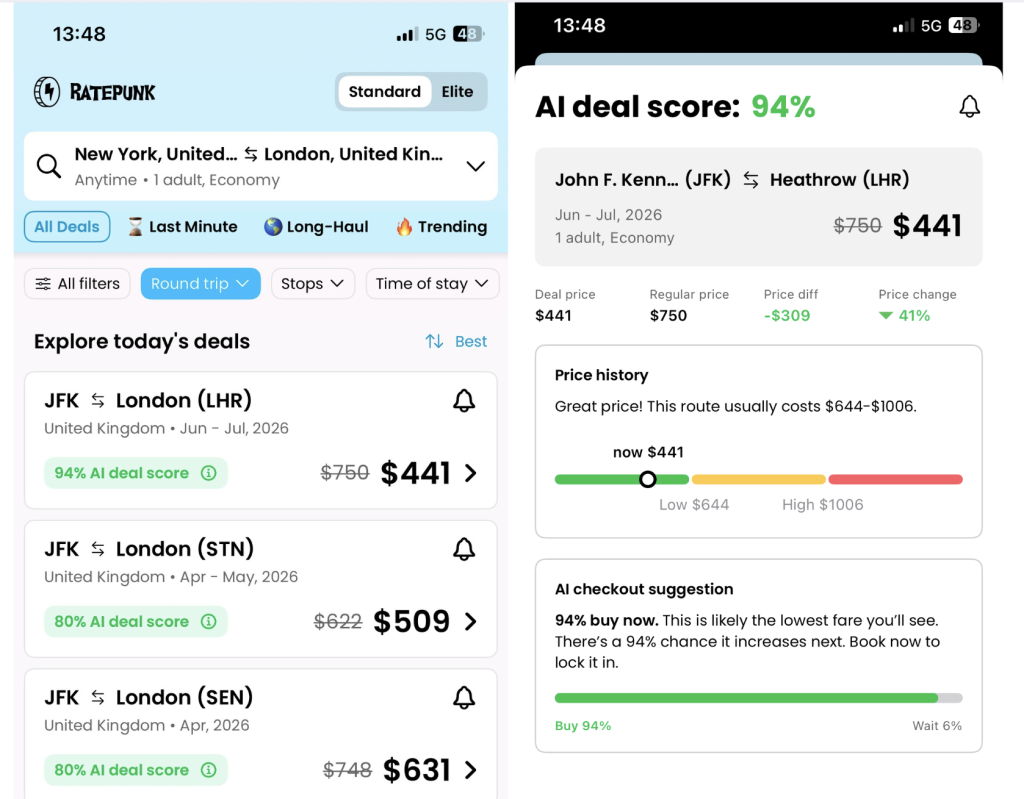
He booked it the same day. Within 24 hours, the price had jumped back to $750.
The part that made the difference wasn’t the technology – it was the context.
“Knowing a price is low isn’t enough,” says Reeves. “You need to know how low, compared to what it normally costs. That’s what RatePunk gives you. You’re not guessing anymore.”
It takes less than a minute to set up – and the math is hard to argue with
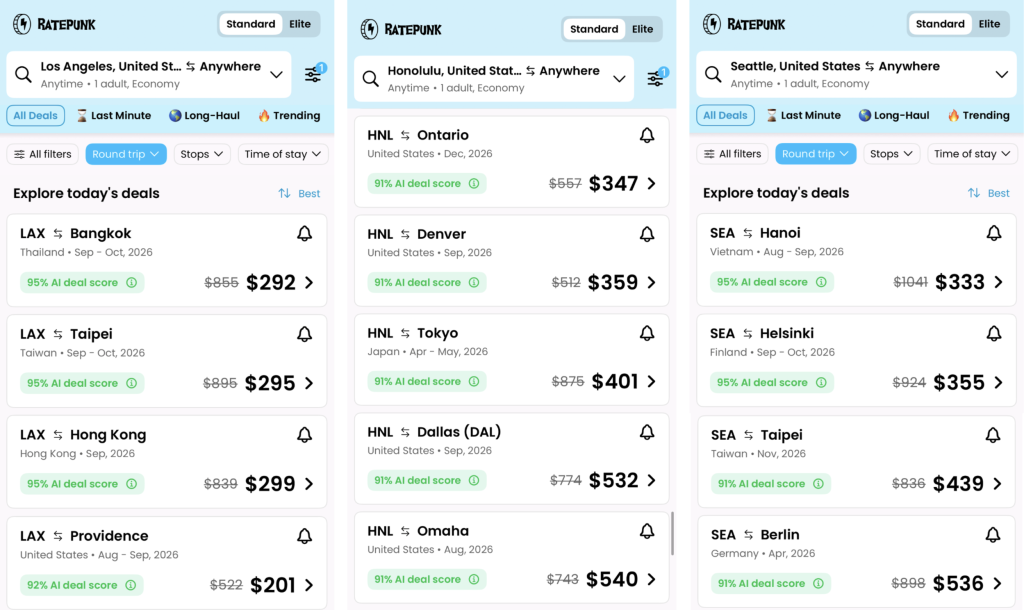
RatePunk monitors 100+ booking sites around the clock and compares every fare against months of historical pricing data for that exact route. When a genuinely good deal appears – the kind that disappears within 24-48 hours – it sends a simple alert to your inbox with the route, the dates, the price, and a direct link to book.
No dashboards to check. No tabs to refresh. You just read the email.
“Set your preferences once, and let it monitor for you,” says Reeves. “Whether a deal appears at 3pm or 3am, you’ll know about it before anyone else.”
The membership costs $23.99 per year – less than $2 per month. Most users report saving $300-500 annually just by booking when the data actually supports it.
“If you’ve ever finished booking a flight and immediately wondered whether you overpaid,” Reeves adds, “this is worth a look. The deals are real. You just need the right information to recognize one when you’re looking at it.”
P.S. There’s currently an 89%-scored deal from Los Angeles to Tokyo for $487 round trip. The 30-day average for that route is $841. That’s $354 below normal pricing – and based on typical patterns, the algorithm will correct it within 24-48 hours. The deals are real. You just need the right information to know when you’re looking at one.


