
 Victoria

A 12-year airline insider admits small price drops are there to make you stop looking. The real deals are 80% to 93% below the usual fare, they are never advertised, and they disappear within hours.
By Victoria, TopTravel News
Your phone lights up: “Good news! Your flight to Tokyo just dropped $40.”
You feel smart. You book. You tell your spouse you got a deal.
You didn’t.
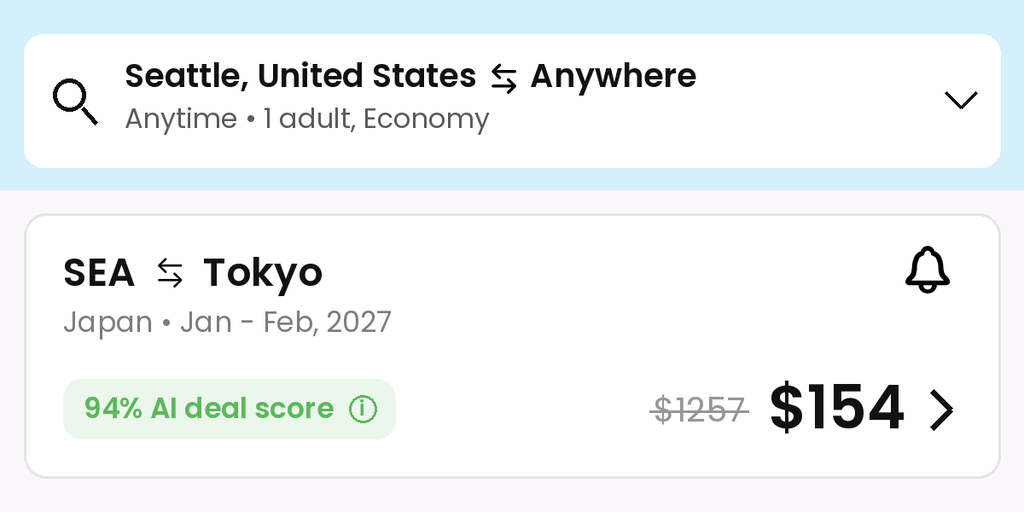
On 1 November, a round trip from Seattle to Tokyo sold for $154.
The usual fare on that route is $1,257. That’s not $40 off. That’s $1,103 off.
“A $40 drop is noise,” says Daniel Robertson, who spent 12 years setting fares as an airline pricing manager. “We moved prices that much all day long. And we were delighted when passengers thought it meant something.”
“Here’s the part I’m not proud of.”
“A small price drop is the best sales tool an airline has,” Robertson says. “You see a little green arrow, you feel like you’ve won, and you stop looking. You’ve still paid nearly full fare. That’s exactly what we wanted.”
A real deal looks nothing like that.
“It’s not 5% off. It’s 70%, 80%, sometimes 90% below what the route normally costs. They turn up every week, and almost nobody sees them.”
What happened on 1 November
Between 31 October and 2 November, fares to Japan collapsed from around fifteen US cities at once.
Seattle to Tokyo, $154. Los Angeles to Osaka, $155. New York to Tokyo, $271.
These routes usually cost $1,100 to $1,600.
There was no sale, no banner, no email from the airline. By 3 November, the fares were gone.
“That’s how the real ones behave,” Robertson says. “They show up without warning and leave the same way. Most are live for hours. No person can check every route and every date often enough to catch them.”
You need a machine watching the machines
The one Robertson points people to is called RatePunk.
It scans 150 million fares a day across more than 100 providers and scores each one from 0 to 100 against what that route usually costs.
A $40 drop scores nowhere near high enough, so you never hear about it.
Only the rare fares rated 80+ reach you: a push notification with the route, the dates, the price, and a link straight to the booking page.
You book directly with the airline.
I missed Tokyo. I didn’t miss Lisbon.
I had an ordinary price alert set for Japan this autumn. It sent me a cheerful note about a $38 drop, and I nearly booked.
Then Robertson showed me the $154 fare. Same country, same week. I felt sick.
I set up RatePunk that night. It took under a minute.
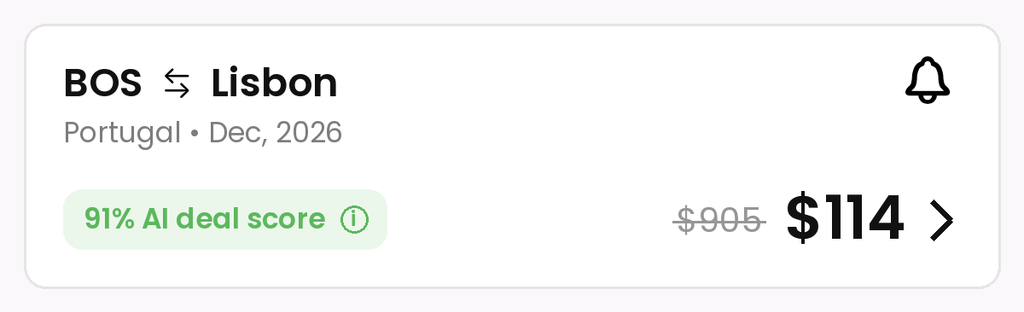
Eleven days later my phone buzzed: Boston to Lisbon, $114 round trip. The usual fare is $905.
That fare was live for a single day. I booked it within the hour.

This is what a real deal looks like
Three fares RatePunk caught this year. All of them are gone now.


Additional fares RatePunk users caught this year:
→ Chicago to Reykjavik – $87 round trip, usually $666, 87% off, caught in June
→ New York to Madrid – $129 round trip, usually $816, 84% off, caught in October
→ New York to Aruba – $213 round trip, usually $930, 77% off, caught in October
→ Los Angeles to Osaka – $155 round trip, usually $1,117, 86% off, caught in November
None of these was a “price drop”. Each was a real fare on a real booking page, and none of them lasted.
The people who got them weren’t smarter than you. They were told first.
You have nothing to lose, except the next $154 flight to Tokyo.
You can keep trusting the little green arrow.
Or you can see what a real deal looks like, from your own airport, in about a minute.
The next one is already on its way. Make sure it’s your phone that buzzes.
| IMPORTANT NOTE: Since this article was published, RatePunk has seen a surge of sign-ups. As a courtesy, readers here can still join with 77% off. |
Sources: Deal figures: RatePunk fare records, June – November 2026.


