
 Ingrid
 Airlines are moving their pricing to AI that works out what a route will bear, but it can’t hide a cheap fare it’s selling, and that short, public window is what travelers catch.
By Ingrid, a travel-agency data analyst who tracks how airfares move.

Dana Reyes had been checking flights to Milan for weeks.
On 30 July, her phone showed her Los Angeles to Milan for $215 round trip. The route usually runs $627.
No trick, no incognito tab. An alert caught it.
Readers often ask me if an ordinary traveler can still win when a machine sets the price.
It’s a fair question, because airlines are moving their prices to AI.
Delta already uses AI to set about 3% of its domestic fares and aims for about 20%, ABC News reported.
Three US senators warned this could push fares “up to each individual consumer’s personal ‘pain point'”.
Delta says its pricing never uses personal data.
Their software finds the most a route will bear.
Every flight is sold in price tiers, called fare buckets.
As AltexSoft and OAG explain, airlines reprice them all day as seats sell.
Pricing software is good at that. It works out the most a route will bear.
Most of us fight back with folklore, but incognito tabs and booking on a Tuesday don’t beat it, as Thrifty Traveler has shown.
In the fares I track, one pattern never changes. There’s one thing the machine can’t do.
To sell a seat, the airline’s AI has to show its price.
A fare that isn’t shown can’t be sold.
So when seats aren’t selling, or a rival moves, a cheap fare has to go public. That’s the opening travelers use.
Cheap fares stay open for minutes to hours. As Going puts it, unusual fares tend to vanish within hours.

Dana is 41 and works as a dental hygienist in Los Angeles. She takes one big trip a year and pays for it herself.
Italy, Milan first, had been on her list for years.
For weeks, she checked fares every night, hoping the price would drop. It only climbed.
She tried a private browser window and waited for Tuesdays. Every night, the same search, and no low fare.
She figured the machine had won, and she closed the tab on Milan.
She didn’t need to beat the airline’s software. She needed software of her own, watching for the least.
Two algorithms watch the same route.
It’s an app called RatePunk.
Their software works out the most a route will bear. This one watches for the least.
RatePunk scans 150M fares a day across 100+ providers and watches your home airport 24/7.
Every fare gets an AI Deal Score from 0 to 100. Only fares rated 80+ reach you, as a push notification on your phone:
• Route – a flight from your home airport
• Dates – the travel dates at that price
• Price – the fare, and what the route usually costs
• Link – straight to the booking page
Let the software watch the fares. You just get the ping.
Dana set Los Angeles as her home airport and stopped searching.
On 30 July, the ping came.
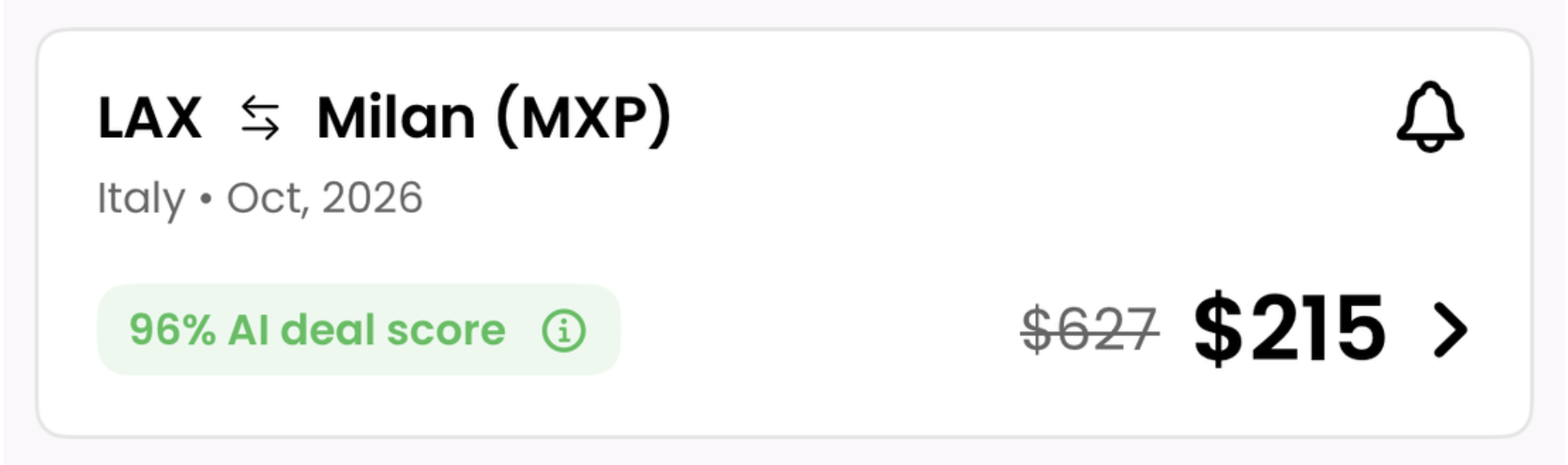
The machine had to show these six fares.
→ Los Angeles to Milan: $215 round trip, typically $627 (rated 96/100), caught 30 July 2026
→ New York to Casablanca: $195 round trip, typically $521 (rated 96/100), caught 30 July 2026
→ Seattle to Bali: $659 round trip, typically $1,458 (rated 93/100), caught 4 September 2026
→ Seattle to Honolulu: $280 round trip, typically $587 (rated 94/100), caught 7 September 2026
→ Chicago to Helsinki: $497 round trip, typically $1,124 (rated 93/100), caught 15 September 2026
→ Chicago to London: a $693 route flagged at $50, a real, bookable error fare (rated 96/100), caught 2 September 2026
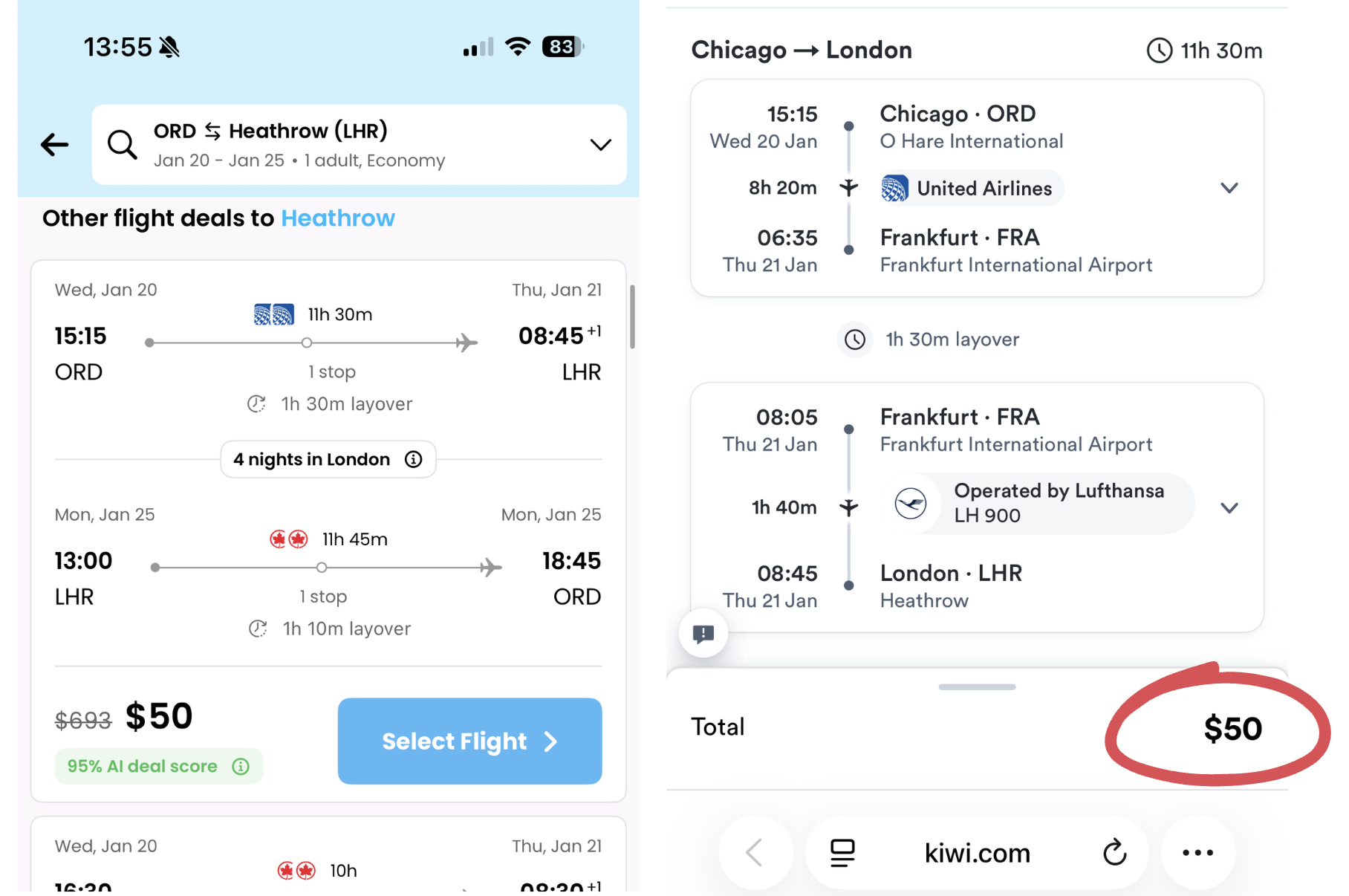
The biggest drop above is 93%, a rare error fare. That is where “up to 90%” comes from, not from a promise.
And these aren’t six lucky fares. RatePunk logged 300 economy fares rated 80+ this summer, median $364 below the usual fare.
Over 300,000 members use RatePunk. It’s rated 4.7 on the App Store and 4.6 on Google Play.
Laurent H. from the US wrote: “RatePunk is easy to use and gives the peace of mind that I get the best prices when shopping for flights.”
Dana booked Milan that same afternoon, with the airline herself.
RatePunk isn’t a booking site. It shows you the fare, and you book it with the airline or booking site.
It works from your city too. You set your home airport, set city-to-city routes, or pick Anywhere, Anytime.
And most fares never clear 80. So when your phone pings, it’s a fare worth booking.
Dana didn’t outsmart the machine. It had to show her the fare.
She’d spent weeks trying to outguess the airline’s software.
In the end, she didn’t have to. The software had to show her the fare, and something was watching.
The machine sets the price. It just can’t keep the cheap ones secret.
| IMPORTANT NOTE: Since this article was published, RatePunk has seen a surge of sign-ups. As a courtesy, readers here can still join with 77% off. |
Sources: ABC News • AltexSoft • OAG • Going • Thrifty Traveler • Deal figures: RatePunk app screenshots, 30 July, 2, 4, 7 and 15 September 2026 • 300 economy fares rated 80+ logged from RatePunk app screenshots, 30 July–7 September 2026.


