
 Victoria
Do you really think people who worked in travel search for flights on the big booking sites – out of Toronto, Calgary or Montreal?
By Victoria, TopTravel News

Vancouver to Belize City, round trip, for C$469. The usual fare on that route is C$1,311.
Would you have found it by typing the route into a big flight search site? Almost certainly not.
As an ex-travel agent, I can tell you that people in the industry rarely search the way you do – we simply never relied on it.
And in Canada it matters more. The Competition Bureau called concentration in the domestic airline market “extremely high”, and found that fares drop 9% on average when just one new competitor enters a route.
Think of airline fares like a massive, chaotic thrift store.

The good finds are in there, but you will never get them by grabbing the first item on the rack.
The big search sites show you the front of the rack.
I don’t want to fuel conspiracy theories. The reality is simpler than that.
First, prices move all day, so a search site often shows you a price saved from earlier, not the low that appeared an hour ago.
Second, the cheapest fares are short-lived. A seat gets repriced, a cheap one opens up, and minutes or hours later it’s gone.
Third, nobody can search every route out of their city, every day, at every hour.
So the fare you’re shown is the fare that was still sitting there when you looked – not the best one that came and went.
Catching these drops yourself would be a full-time job.
You’d need to refresh dozens of routes out of your airport, day and night, and know what each one usually costs.
It’s a volume of data no person can keep up with.
You don’t need more time to search – you need something that searches for you.
It’s called RatePunk, and it’s wonderfully simple.
Behind the scenes, it scans 150M fares a day across 100+ providers. It runs 24/7.
Every fare gets an AI Deal Score from 0 to 100. Only fares rated 80+ ever reach you.
You pick your home airport – or a city-to-city route, or Anywhere, Anytime – and when a fare rated 80+ appears, your phone gets a push notification with only the essentials: route, dates, price and a link to the booking page.
RatePunk isn’t a booking site. You book with the airline or booking site yourself.
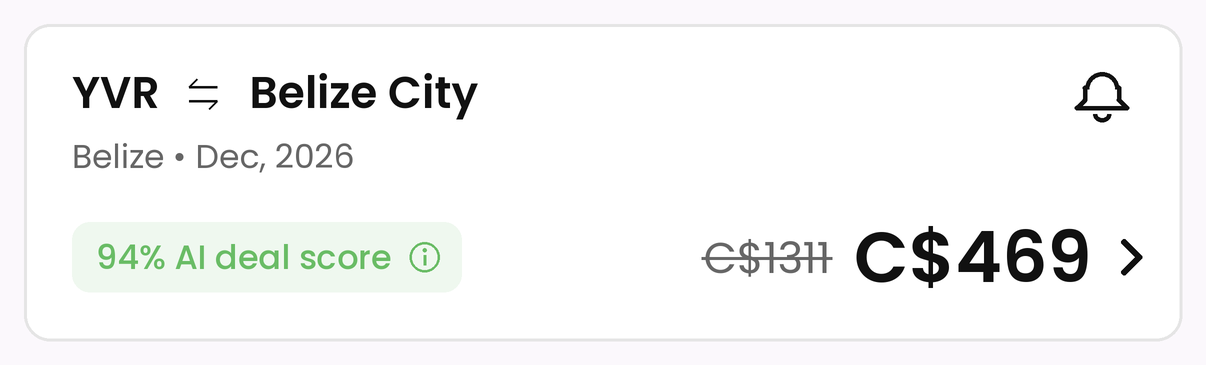
Here’s what fares like these look like out of Canadian airports.
→ Vancouver to Belize City – C$469 round trip, usually C$1,311 (rated 94/100), caught 15 Sep 2026
→ Toronto to Antigua – C$458 round trip, usually C$1,149 (rated 91/100), caught 15 Sep 2026
→ Edmonton to St. George’s, Grenada – C$601 round trip, usually C$1,489 (rated 94/100), caught 11 Sep 2026
→ Ottawa to Anchorage – C$522 round trip, usually C$1,123 (rated 91/100), caught 11 Sep 2026

The biggest drop above is 64%. That is where “up to 64%” comes from, not from a promise.
These are fares RatePunk has already found. Fares like these stay open for minutes to hours before they’re repriced, which is exactly why something has to be watching.
More than 300,000 members use it, and it’s rated 4.7 on the App Store and 4.6 on Google Play.
“But does it work from my city?”
Yes. You choose your home airport, a city-to-city route, or Anywhere, Anytime if you’re flexible.
If your dates are fixed, you can set an alert for those exact dates, and the app tells you when a good fare appears.
And if it looks too good to be true? Most fares never clear 80. The ones that do are the rare ones – which is the whole point.
The cheapest fares out of Canada don’t wait for you to search again.
They show up and disappear between your searches.
You can keep refreshing the front of the rack. Or you can let something watch the whole store and tap you on the shoulder when the good one turns up.
That, to me, is what modern travel should look like: technology doing the hard part, and you getting a simple, clear choice.
| IMPORTANT NOTE: Since this article was published, RatePunk has seen a surge of sign-ups. As a courtesy, readers here can still join with 77% off. |
Sources: Competition Bureau (via The Canadian Press) • Mighty Travels • Deal figures: RatePunk app, 11 and 15 September 2026.


