
 Victoria
 For years I tried every booking trick Canadians swear by. Then I read what the airlines’ pricing systems actually do. The old tricks don’t beat that system. One thing still does.
By Victoria, TopTravel News.

Let me give you the number that ended the old advice.
Reported this year: dynamic pricing now adjusts fares in real time, and it has erased the predictable booking “sweet spots” people relied on for years. Prices swing without warning.
So the Tuesday rule, the book-six-weeks-out rule, the clear-your-cookies trick, even the classic Buffalo run, driving across the border to fly cheaper.
They’re not strategies anymore.They’re folklore.
I understand why people held on. I held on too. For a while, those patterns were real. Then the pricing software caught up, and nobody sent a memo.
What the system is actually doing
Here’s the part that took me longest to accept. The airline isn’t pricing the seat. It’s pricing you.
Every flight is split into dozens of invisible price tiers inside one cabin. The system reads demand in real time, how many people are searching, how fast seats are selling, then shows you a number close to the most it thinks you’ll tolerate.
Canadians feel it more than most. Fewer carriers compete out of Toronto, Calgary or Halifax, so the algorithm rarely gets punished. The Competition Bureau’s 2025 market study said as much: less competition on a route means higher fares.
Comparison sites like Google Flights don’t fix this. They show you what’s loaded right now, not whether it’s fair or about to move.
What it costs you
Two passengers in the same row can pay very different prices for identical seats, depending on which price tier was open when each of them looked. Sitting in the wrong bucket quietly costs hundreds, per flight, per person.
You never see it, because there’s no “before” price to compare against. You just pay.
Anna stopped flying as much, and blamed herself
Anna is 41, from Mississauga. For years she flew once a year with her husband and two kids. Four seats, one trip, usually somewhere warm in February.
The kids are grown now, and two tickets cost her about what four used to.
She assumed she’d gotten worse at booking. She hadn’t. The fares had drifted up around her while she kept using the same old tricks.
So she started flying less. That’s the real cost: not the dollars, the trips that quietly stop happening.
The problem was never when Anna searched. It was that she was searching at all
One person, by hand, against a system that never sleeps. That math doesn’t work.
The airline runs an algorithm against you. RatePunk runs one for you.
RatePunk is a flight deal app that watches fares from your home airport 24/7, scanning 150 million fares a day. Its AI Deal Score rates every fare 0 to 100, based on price history, savings, route distance and timing, and only fares scoring 80 or higher reach you.
So you stop hunting. The good fare finds you.
What one of these deals looks like
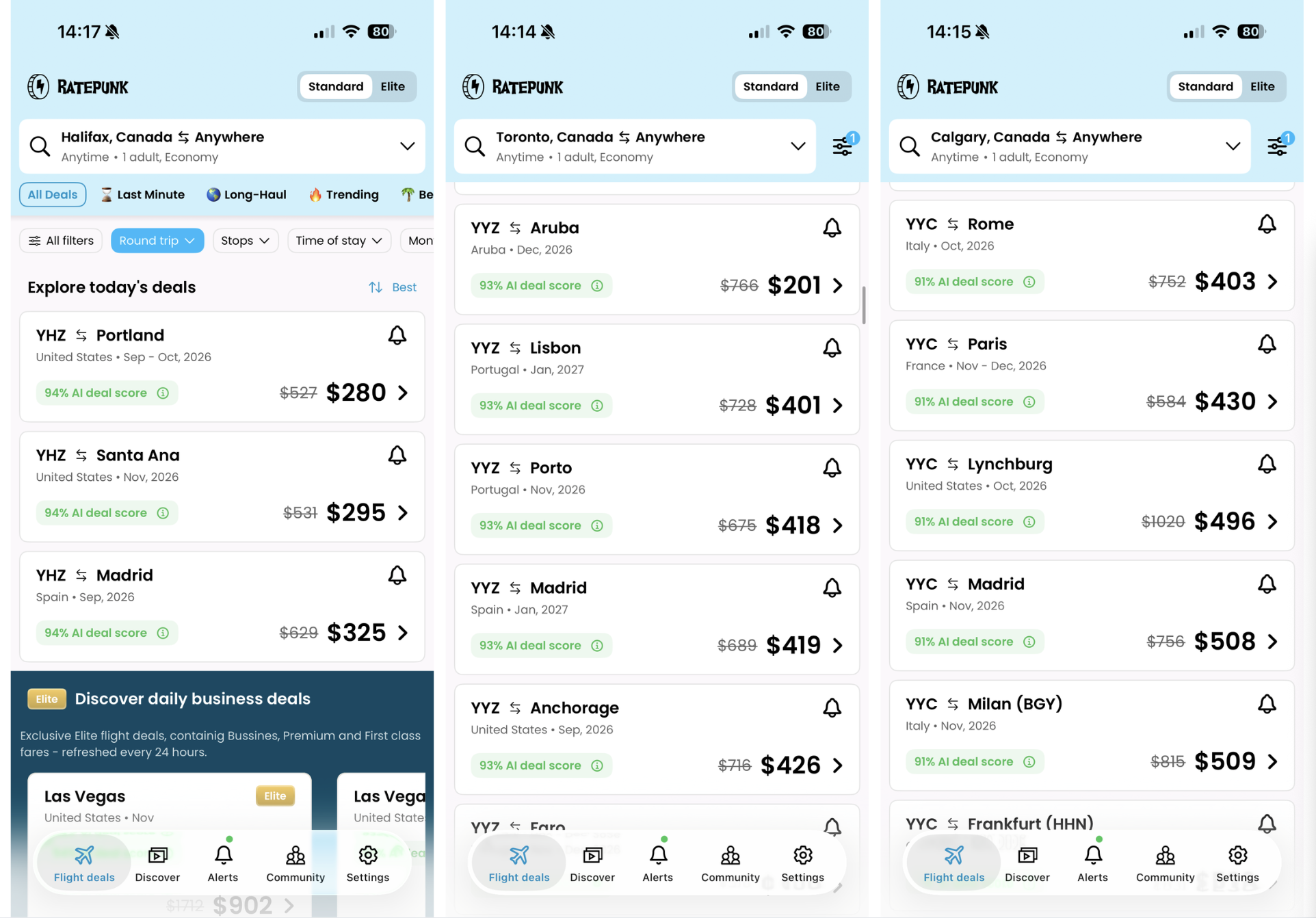
Let me show you the app, because the app is the whole product.
You set your home airport once: Pearson, YUL or YYC. The system watches your routes around the clock. When a fare scores 80 or higher, a notification lands on your phone with four things and nothing else:
• The route, a flight leaving from your airport
• The dates, the exact days the low fare is live
• The price, the fare, and what you’re saving
• The link, straight to the booking page before it moves
The job that used to take all day happens while you’re doing something else.
What members in Canada are actually seeing
From Canadian airports this year, RatePunk has flagged economy fares up to 80% below the usual price.
→ Montreal to London: C$208 round trip, usually C$1,713 (rated 96/100)
→ Toronto to Paris: C$209 round trip, usually C$1,310 (rated 96/100)
→ Calgary to Delhi: C$481 round trip, usually C$2,629 (rated 94/100)
→ Halifax to Dublin: C$361 round trip, usually C$1,300 (rated 94/100)
→ Toronto to Barcelona: C$312 round trip, usually C$1,278 (rated 96/100)
The biggest drop above is 88% – that is where “up to 80%” comes from, not from a promise.
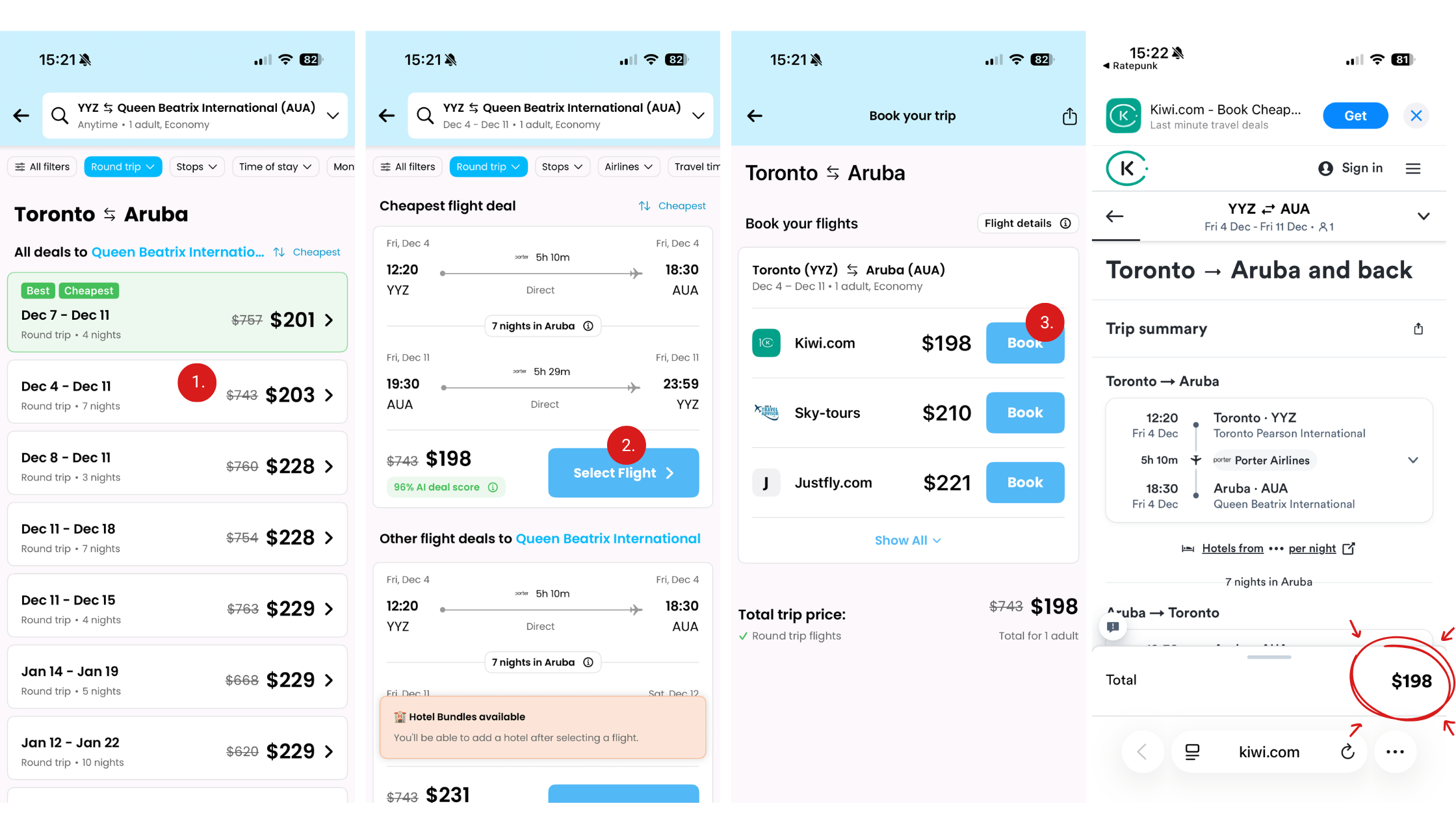
That’s the kind of fare I used to spot once and never again, now reaching people before the system corrects it.
Over 300,000 members already run it in the background.
What happened to Anna
There’s a footnote to Anna’s story. She set it up after we talked: home airport, two routes, about a minute.
Three weeks later, a notification pinged on her phone: Toronto to Paris, C$209 round trip, on a route that typically runs C$1,310. Deal Score: 96.
A trip she and her husband had talked about for two years and kept putting off because “it wasn’t the right year.”
They booked it that evening. “I didn’t search for it,” she told me. “It just pinged while I was making dinner.”
That’s the part the old tricks can’t touch. The trip that had quietly stopped happening started happening again, and she never opened a single tab, and never had to drive to Buffalo.
| IMPORTANT NOTE: Since this article was published, RatePunk has seen a surge of sign-ups. As a courtesy, readers here can still join with 77% off. |
There’s little to lose by testing it
Setup takes about a minute. Pick your airport, set your routes, let it run against your next trip, the March break escape or a winter week somewhere warm.
If a deal lands, you’ll see exactly what the old tricks were never going to find. If it doesn’t, you’ve spent a minute.
• Set your home airport once
• Let it watch fares 24/7
• See only fares scored 80 or higher
• Get the alert with a direct booking link
One note on timing: the best fares stay visible only briefly before airlines reprice. That’s not a sales deadline, it’s how dynamic pricing works. Being watched 24/7 means you’re in position when one appears.
Sources: Thrifty Traveler • Competition Bureau of Canada • AltexSoft • Mighty Travels • Going • Deal figures: RatePunk app and RatePunk fare data, fares found 23 June, 24 June and 17 July 2026; app screenshots 2 and 4 September 2026.


